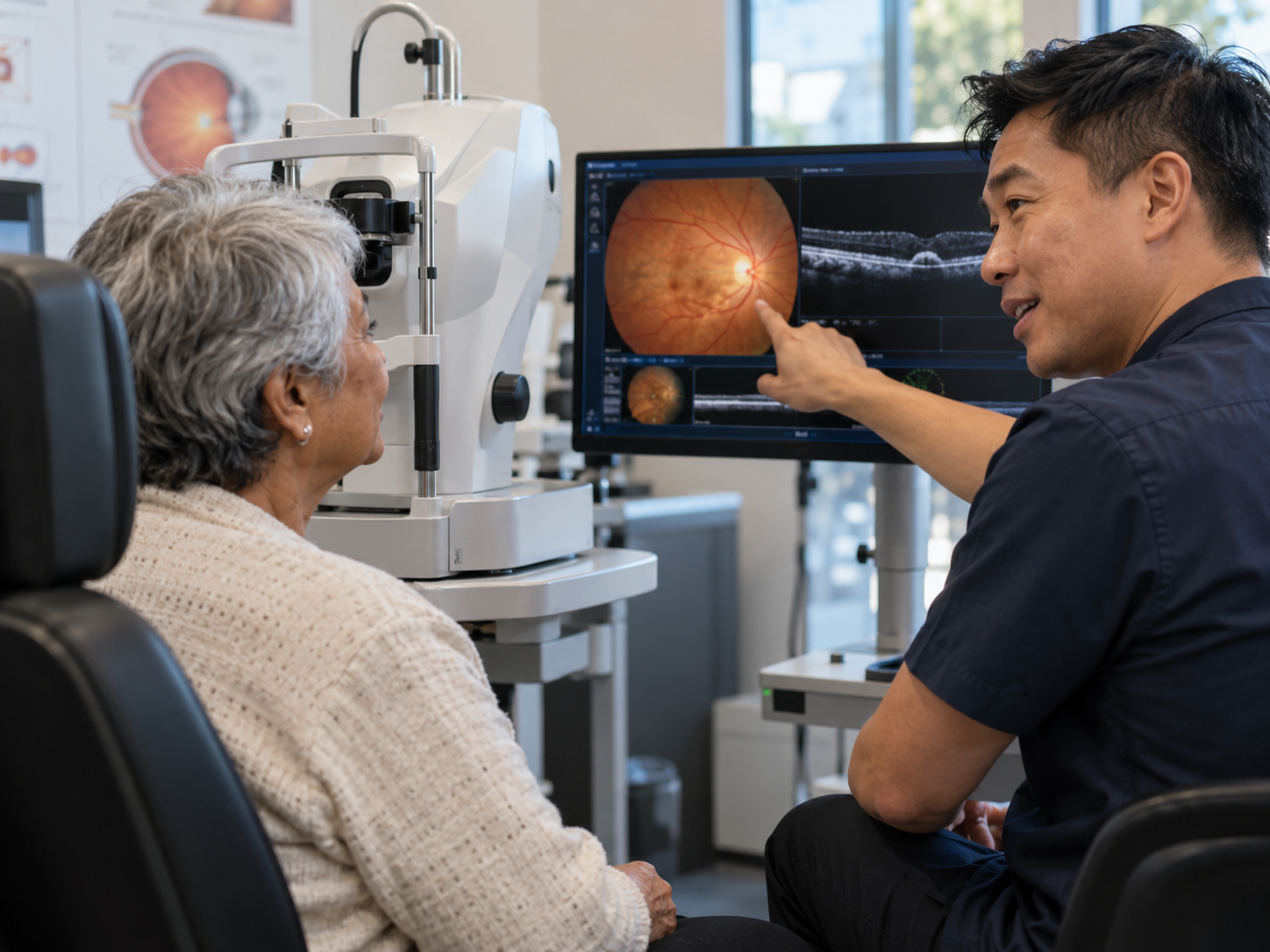
Macular degeneration
Specialist care to help protect your central vision.
Age-related macular degeneration (AMD) is an eye condition that affects the macula, the central part of the retina responsible for sharp, detailed vision.
The macula allows us to perform everyday activities such as reading, recognising faces and driving. When it becomes damaged, central vision can become blurred, distorted or less clear.
There are two main forms of age-related macular degeneration: dry AMD and wet AMD. Dry AMD generally progresses more slowly, while wet AMD can cause rapid changes in vision due to abnormal blood vessels growing beneath the retina.
Although there is currently no cure for AMD, early detection, monitoring and appropriate treatment can help preserve vision and manage the condition.
Riverina Eye Care Centre provides specialist assessment and management of macular degeneration, including diagnostic imaging and treatment options for suitable patients.
Our ophthalmologists work closely with patients to monitor changes in their vision and provide ongoing care to support their eye health and independence.
Medical treatment for macular degeneration
Managing macular degeneration through personalised treatment and monitoring.
Treatment for age-related macular degeneration depends on whether the condition is classified as dry or wet AMD, as well as its stage and severity.
For dry AMD, management may include regular eye examinations, retinal imaging and advice on lifestyle factors that can influence disease progression. Certain nutritional supplements may be recommended for patients with specific stages of AMD, although they are not suitable or necessary for everyone.
Wet AMD generally requires more active treatment, as abnormal blood vessels can leak fluid or blood beneath the retina, potentially causing rapid vision loss.
Anti-vascular endothelial growth factor (anti-VEGF) medications are commonly used to treat wet AMD. These medications help control abnormal blood vessel activity and reduce fluid leakage.
At Riverina Eye Care Centre, we provide ongoing assessment and individualised treatment planning for patients with macular degeneration.
Regular monitoring allows our ophthalmologists to identify changes, assess treatment effectiveness and recommend adjustments when necessary.


Intravitreal injections
Targeted treatment to help manage retinal conditions and preserve vision.
Intravitreal injections are a treatment used for a range of retinal conditions, including wet age-related macular degeneration, diabetic macular oedema and certain retinal blood vessel disorders.
The procedure involves delivering medication directly into the vitreous, the gel-like substance inside the eye. This allows treatment to reach the retina, where it can help control abnormal blood vessel growth, fluid leakage and swelling.
Anti-VEGF medications are among the most commonly used treatments and can help stabilise or improve vision in suitable patients.
Before the injection, the eye is numbed with anaesthetic drops and carefully cleaned to reduce the risk of infection. The injection itself is usually brief, although some discomfort or irritation may occur afterwards.
Depending on the condition, patients may require a series of injections and ongoing monitoring to maintain the benefits of treatment.
At Riverina Eye Care Centre, our ophthalmologists provide personalised assessment and treatment planning, explaining the procedure, potential risks and expected follow-up requirements.